


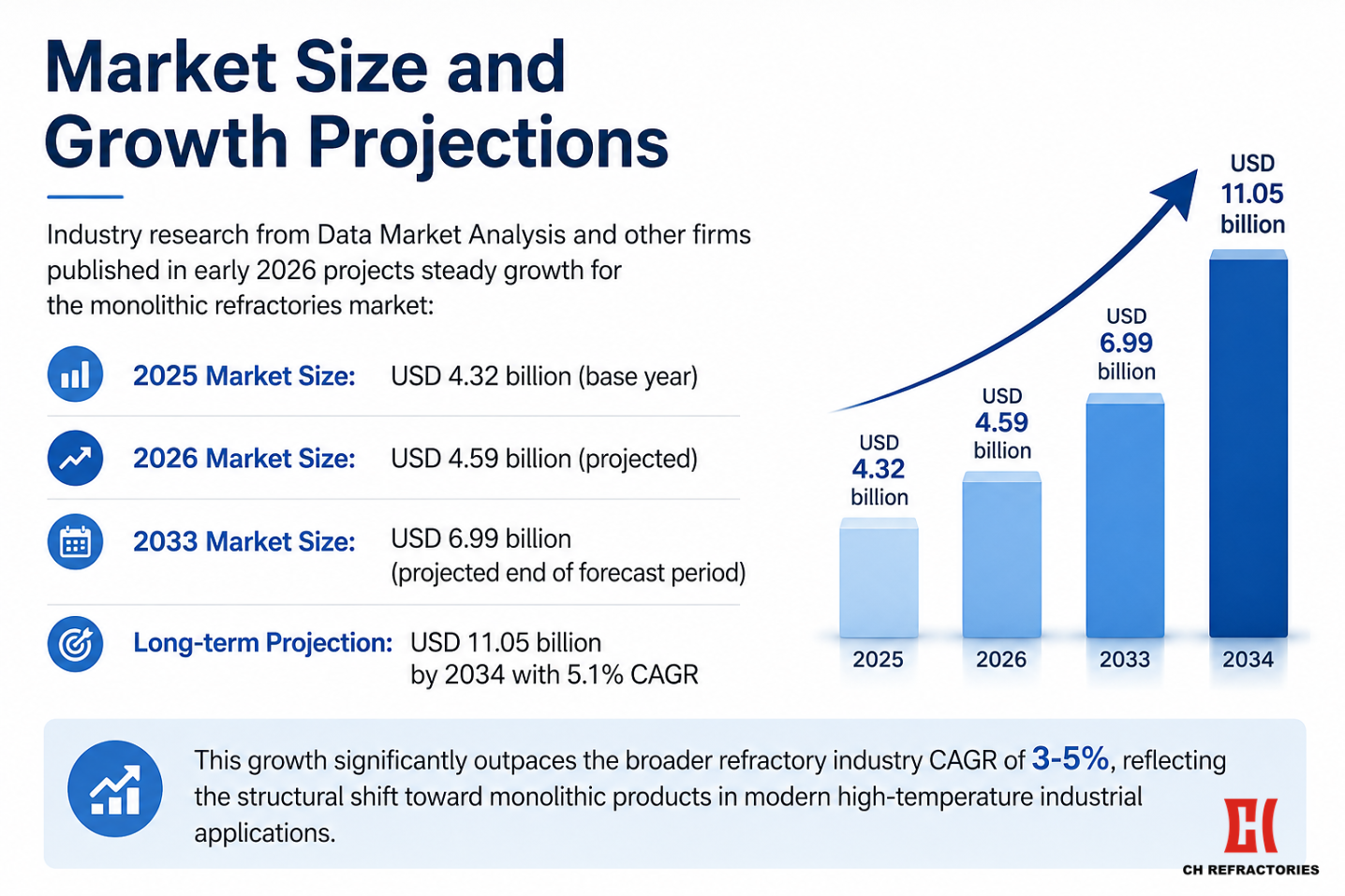

The global monolithic refractories market is currently experiencing significant growth, driven by increasing demand for high-performance materials and installation efficiency across steel, cement, and industrial furnace applications. According to multiple 2026 industry research reports, the market is projected to reach USD 11.05 billion with a 5.1% CAGR, reflecting strong structural transformation in refractory consumption patterns.
Market Size and Growth Projections
Industry research from Data Market Analysis and other firms published in early 2026 projects steady growth for the monolithic refractories market:
- 2025 Market Size: USD 4.32 billion (base year)
- 2026 Market Size: USD 4.59 billion (projected)
- 2033 Market Size: USD 6.99 billion (projected end of forecast period)
- Long-term Projection: USD 11.05 billion by 2034 with 5.1% CAGR
This growth significantly outpaces the broader refractory industry CAGR of 3-5%, reflecting the structural shift toward monolithic products in modern high-temperature industrial applications.
Why Monolithic Refractories Are Growing Faster
Several structural factors drive monolithic refractories growth faster than shaped bricks:
- Installation Efficiency: Monolithic castables eliminate the joints inherent in brick construction. This reduces installation time by 30-50% and improves lining integrity.
- Complex Geometry: Cast-in-place linings accommodate complex furnace shapes that would be difficult or impossible with shaped bricks.
- Hot Repair Capability: Gunning mixes and patching castables enable in-service repairs without furnace shutdown, extending campaign life.
- Improved Performance: Modern low-cement and ultra-low-cement castables deliver performance approaching shaped bricks while maintaining installation flexibility.
- Reduced Inventory: Bulk castable delivery reduces material handling and on-site inventory versus brick stocks.
CH Refractories Monolithic Product Portfolio
CH Refractories supplies a comprehensive monolithic product portfolio serving steel, cement, glass, and industrial furnace applications:
- Steel Industry: Ladle Working Layer Gunning Mix, Anti-seepage Castable, EAF Gunning Mixes, Tundish Permanent Lining Castable
- Cement Industry: Anti-Crust Castable for Cement Kiln, High Strength Alkali Resistant Castable, Coal Pipe Castable
- Industrial Furnace: Low Cement Castable, Light Weight Castable, Plastic Refractories
Regional Market Dynamics
The monolithic refractories market shows distinct regional patterns:
- Asia-Pacific: Largest market share driven by Chinese and Indian steel industry capacity. Monolithic products preferred for new installations and modernized facilities.
- Europe: Steady demand driven by EAF expansion and decarbonization investments. Premium low-cement castables favored.
- North America: Growing market with emphasis on hot repair programs extending campaign life in aging blast furnaces.
- Middle East & Africa: Emerging market with infrastructure-driven demand for cement and steel plant refractory solutions.

Innovation Trends 2026
Industry research identifies several innovation directions shaping monolithic refractory development:
- Nano-Bonded Castables: Emerging nano-structured bonding systems delivering enhanced strength and thermal shock resistance.
- Self-Healing Formulations: Castables with embedded additives that heal micro-cracks during service, extending campaign life.
- Sustainable Materials: Recycled refractory aggregates and low-carbon cement binders addressing sustainability goals.
- Smart Castables: Embedded sensors for real-time temperature and wear monitoring in critical zones.
Monolithic refractories represent the fastest-growing segment of the global refractory industry, driven by installation efficiency, complex geometry capability, and hot repair advantages. Modern industrial operations increasingly prefer monolithic solutions for both new installations and ongoing maintenance.
Contact CH Refractories for monolithic refractory selection and engineering consultation.
CH Refractories Engineering Team
40+ years of refractory engineering experience · Steel · Cement · Glass · Nonferrous